

Mean reversion strategies rely on the premise that extremes in price eventually revert to the mean price over time. They are effective during established markets – bull, bear or sideways – but unfortunately do not perform well during market regime changes or tail events. Tail events are outcomes that have …
Category: Mean Reversion

I was recently asked to be interviewed by Andrew Swanscott who runs bettersystemtrader.com. If you haven’t heard of this site before, it’s well worth a visit. Many of the trading legends that I have studied during the past ten years have shared their insights with Andrew during a Podcast. I …
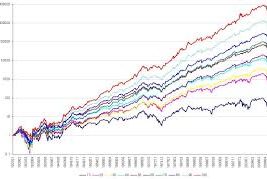
I’ve been doing some research around something called External Relative Strength (ERS). ERS measures the stock’s price performance relative to all other listed equities. Basically, it measures how well or poorly a stock is performing relative to its’ peers. Our research suggests that the market has a strong propensity to …

Few propositions in economics are held with more fervour than the view that financial markets are “efficient”, or that future price changes are unpredictable. Another strongly held view is the random walk hypothesis, which state that stock prices evolve according to a random walk and thus cannot be predicted. If …

In this post I’ll review a simple strategy that I developed many years ago that attempts to exploit reversion to the mean. I’ve named the strategy Jaws due to the Jaw like pattern that the indicators exhibit before an entry condition occurs. The rules: Buy on the close when the …